Austria Living Cost Guide 2026
Your complete guide to salaries, expenses, taxes, and purchasing power in Austria
Last updated: June 2026 | Next review: December 2026
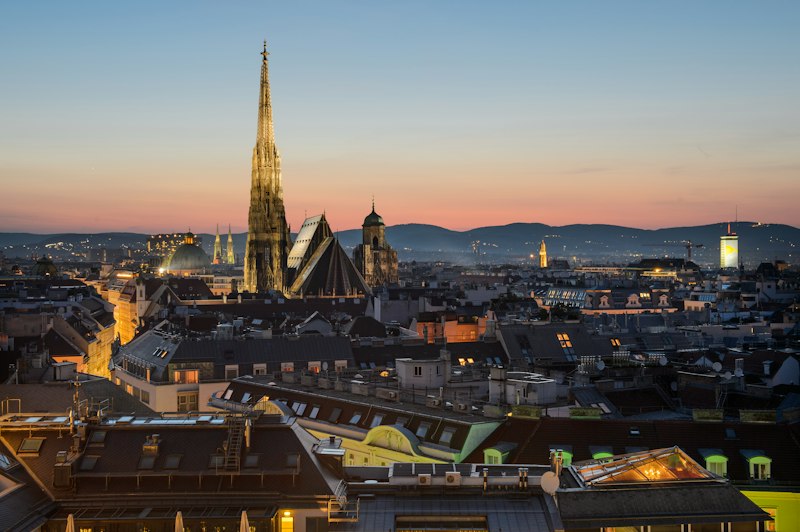
Your complete guide to salaries, expenses, taxes, and purchasing power in Austria
For a single adult. All amounts in EUR. Based on Statistik Austria, real 2026 data, and expat reports.
| Category | Item | Low (EUR) | High (EUR) | Notes |
|---|---|---|---|---|
| Housing | ||||
| Rent (1-bedroom apartment) | 800 | 1,200 | Vienna varies by Bezirk; Altbau rent-controlled cheaper | |
| Utilities (electricity, heating, water) | 150 | 250 | Betriebskosten; gas heating higher in winter | |
| Internet | 25 | 40 | A1, Magenta, Drei; fiber widely available | |
| Mobile phone | 10 | 25 | HoT, Spusu, bob offer budget plans from 6 EUR | |
| GIS (ORF Rundfunkgebuehren) | 22 | 22 | Mandatory TV/radio fee per household | |
| Housing subtotal | 1,007 | 1,537 | ||
| Food & Groceries | ||||
| Groceries | 300 | 450 | Billa, Hofer (Aldi), Spar, Lidl; Hofer cheapest | |
| Dining out (occasional) | 50 | 120 | Beisl (pub) lunch menus 8-12 EUR | |
| Food subtotal | 350 | 570 | ||
| Transport | ||||
| Wiener Linien monthly pass | 51 | 51 | Jahreskarte (annual) = 365 EUR = 1 EUR/day | |
| Occasional taxi / car sharing | 0 | 80 | Uber, Bolt, SHARE NOW available in Vienna | |
| Transport subtotal | 51 | 131 | ||
| Healthcare | ||||
| Public health insurance (employee share) | 0 | 50 | Covered by payroll deduction; minimal out-of-pocket | |
| Health subtotal | 0 | 50 | ||
| Personal & Lifestyle | ||||
| Clothes | 50 | 120 | ||
| Personal care | 30 | 60 | Haircuts, toiletries, dm/Bipa drugstores | |
| Sport & leisure | 25 | 80 | Gym 25-45 EUR/month; city pools, Donauinsel free | |
| Household supplies | 20 | 40 | Cleaning products, small items | |
| Personal subtotal | 125 | 300 | ||
| Entertainment | ||||
| Cinema, museums, events | 30 | 80 | Many free museums on first Sunday; Staatsoper standing 4 EUR | |
| Streaming / subscriptions | 15 | 30 | Netflix, Spotify, etc. | |
| Entertainment subtotal | 45 | 110 | ||
| TOTAL MONTHLY EXPENSES | ~1,578 | ~2,698 | Realistic range: 1,800 - 2,800 with buffer | |
Monthly gross salaries in EUR. Data from Statistik Austria, Stepstone Gehaltsreport, Glassdoor 2026.
Austria uses progressive income tax (Einkommensteuer) plus mandatory social contributions. Updated for 2026 tax year.
| Annual Taxable Income (EUR) | Tax Rate | Notes |
|---|---|---|
| 0 - 12,816 | 0% | Tax-free allowance (Steuerfreier Betrag) |
| 12,816 - 20,818 | 20% | Lowest bracket |
| 20,818 - 34,513 | 30% | Middle bracket |
| 34,513 - 66,612 | 41% | Upper-middle bracket |
| 66,612 - 99,266 | 48% | High earner bracket |
| 99,266+ | 50% | Top rate (55% on income over 1 million until 2025, reduced) |
| Contribution | Employee Share | Employer Share | Notes |
|---|---|---|---|
| Health insurance (Krankenversicherung) | 3.87% | 3.78% | Via OeGK (Oesterreichische Gesundheitskasse) |
| Pension (Pensionsversicherung) | 10.25% | 12.55% | State pension; generous compared to most EU countries |
| Unemployment (Arbeitslosenversicherung) | 3.00% | 3.00% | Reduced for low earners |
| Other (AK, WF, etc.) | 1.00% | ~1.40% | Arbeiterkammer, housing subsidy (Wohnbaufoerderung) |
| Total | ~18.12% | ~20.73% | Employee pays ~18% of gross |
| Monthly Gross | Annual Gross (14x) | Tax + Social | Net Monthly | Effective Rate |
|---|---|---|---|---|
| 2,500 | 35,000 | ~680 | ~1,820 | 27.2% |
| 3,500 | 49,000 | ~1,100 | ~2,400 | 31.4% |
| 5,000 | 70,000 | ~1,850 | ~3,150 | 37.0% |
| 7,000 | 98,000 | ~2,800 | ~4,200 | 40.0% |
| 10,000 | 140,000 | ~4,200 | ~5,800 | 42.0% |
Compare how far your Austrian salary goes in other countries. Based on World Bank/OECD 2025-2026 PPP indices. Austria = 100.
| Country | Flag | PPP Index | 2,500 EUR buys equiv. of | Comparison |
|---|
Comparing major Austrian cities. Vienna = 100 (most expensive baseline). Data: Statistik Austria, Numbeo, willhaben.at 2026.
| City | Avg Rent 1-bed (EUR) | Monthly Pass (EUR) | Meal Out (EUR) | Beer 0.5L (EUR) | Livability Note |
|---|---|---|---|---|---|
| Vienna | 800 - 1,200 | 51 | 12 - 20 | 4.50 | Most expensive; world's most livable city; extensive U-Bahn |
| Salzburg | 750 - 1,100 | 58 | 12 - 18 | 4.20 | Mozart's birthplace; tourism-driven; Alps on doorstep |
| Innsbruck | 700 - 1,050 | 55 | 11 - 17 | 4.00 | Alpine capital; student city; ski resorts nearby |
| Graz | 550 - 850 | 49 | 10 - 16 | 3.80 | Second largest; university city; affordable & green |
| Linz | 550 - 800 | 48 | 10 - 15 | 3.50 | Industrial hub; Ars Electronica; growing tech scene |
Austria has universal healthcare via OeGK (Oesterreichische Gesundheitskasse). Coverage is automatic for all employed residents.
| Service | Cost | Notes |
|---|---|---|
| GP visit (Hausarzt / Allgemeinmediziner) | Free | Choose a Kassenarzt (contracted doctor) for no co-pay |
| Specialist visit | Free | Referral (Ueberweisung) from GP recommended but not always required |
| Hospital stay (Spitalsaufenthalt) | ~12 EUR/day | Co-payment for up to 28 days/year; varies by Bundesland |
| Prescription drugs | 6.50 EUR per item | Rezeptgebuehr; chronic patients can get exemptions |
| Dental - basic | Covered | Check-ups, fillings covered; crowns/bridges partially |
| Dental - extras (crowns, implants) | Partial / not covered | Private Zahnzusatzversicherung recommended; ~20-50 EUR/month |
| Mental health (Psychotherapie) | Partially covered | OeGK covers some sessions; long waiting lists; Krankenkasse-funded slots limited |
| Maternity (Mutter-Kind-Pass) | Fully covered | All prenatal care, delivery, postnatal check-ups via Mutter-Kind-Pass program |
| Physiotherapy | Partially covered | Requires prescription; OeGK covers portion; small co-payment |
| Feature | OeGK (Public) | Private Zusatzversicherung |
|---|---|---|
| Cost | Automatic via payroll (~3.87% employee) | 100 - 300 EUR/month depending on coverage |
| Hospital room | Shared ward (Allgemeine Klasse) | Private room (Sonderklasse) with choice of doctor |
| Waiting times | Can be weeks for specialists | Faster access, Wahlarzt (private doctor) reimbursement |
| Dental | Basic coverage only | Full coverage including implants and orthodontics |
| Providers | OeGK (universal) | Uniqa, Wiener Staedtische, Generali, Merkur |
The Austrian rental market, especially in Vienna, has unique features like Gemeindebau and Altbau rent control.
| Type | Rent Range (1-bed) | Key Features |
|---|---|---|
| Altbau (pre-1945) | 500 - 900 EUR | Rent-controlled (Richtwertmietzins); high ceilings, charm; lower rents |
| Neubau (post-1945) | 700 - 1,200 EUR | Market rate; modern amenities; no rent cap |
| Gemeindebau (social housing) | 300 - 600 EUR | City-owned; must meet income/residency criteria; waiting lists |
| Genossenschaftswohnung | 500 - 800 EUR | Cooperative housing; upfront Genossenschaftsbeitrag (5,000-30,000 EUR); affordable rent |
| WG (shared apartment) | 350 - 600 EUR | Popular with students; per room in shared flat |
| Platform | Type | Notes |
|---|---|---|
| willhaben.at | All types | Austria's largest classifieds; essential for apartment search |
| ImmobilienScout24.at | All types | Major platform; good filter options |
| WG-Gesucht.de | Shared flats | Also covers Austria; popular for WG rooms |
| derstandard.at/immobilien | All types | Newspaper classifieds; quality listings |
| Facebook groups | All types | "Wohnung in Wien" groups; good for direct landlord contact |
Austria has excellent public transport, the KlimaTicket for nationwide travel, and strong cycling infrastructure.
| Transport Type | Cost | Details |
|---|---|---|
| KlimaTicket Oe (nationwide) | 1,095 EUR/year | All buses, trams, U-Bahn, S-Bahn, regional & long-distance trains (OeBB, Westbahn, etc.) |
| Wiener Linien Jahreskarte | 365 EUR/year | Vienna only; U-Bahn, trams, buses; 1 EUR/day |
| Wiener Linien monthly | 51 EUR/month | Vienna monthly pass; Semester ticket for students ~75 EUR |
| OeBB Wien-Salzburg | 25 - 70 EUR | ~2.5 hours; Sparschiene (advance fares) from 19 EUR |
| OeBB Wien-Graz | 20 - 55 EUR | ~2.5 hours; Railjet trains |
| Westbahn (private rail) | From 15 EUR | Wien-Salzburg route; competitive prices; modern trains |
| Autobahn Vignette | 96.40 EUR/year | Required for all Austrian motorways; 10-day (9.90 EUR) available |
| Car insurance (Kfz-Versicherung) | 60 - 130 EUR/month | Haftpflicht mandatory; varies by Bundesland and vehicle |
| Bicycle (WienMobil Rad) | Free first 30 min | City bike sharing; 25 EUR annual membership; 1,500+ stations |
| E-scooter rental | ~0.22 EUR/min | Tier, Lime, Bird; regulated zones in Vienna |
Austrian employment law, work permits, and practical info for newcomers.
| Topic | Details | Notes |
|---|---|---|
| Rot-Weiss-Rot Karte | Points-based work permit for skilled workers, graduates, key workers | Requires job offer; points for qualifications, language, age, salary; valid 2 years |
| 14 salary payments | 13th (Weihnachtsgeld) + 14th (Urlaubsgeld) month mandatory | Taxed at flat 6% up to threshold; major financial benefit unique to Austria |
| Working hours | Standard 38.5-40 hours/week | Legal max 10h/day, 50h/week with overtime; 12h possible with agreement |
| Vacation (Urlaub) | Legal minimum: 25 working days (5 weeks) | Increases to 30 days after 25 years; unused days carry over |
| Sick leave (Krankenstand) | Employer pays 100% for 6-12 weeks (depends on tenure) | After that: Krankengeld from OeGK (~50% of salary) |
| Probezeit | Probation period, typically 1 month | Either party can terminate without notice; shorter than Germany's 6 months |
| Kuendigungsfrist | Notice period: 6 weeks to 5 months (employer) | Depends on length of service; employee: 1 month notice |
| Betriebsrat | Works council in companies with 5+ employees | Strong co-determination rights; consulted on dismissals |
| Arbeiterkammer (AK) | Chamber of Labour; mandatory membership for employees | Provides free legal advice, consumer protection, tax help; ~0.5% of salary |
| AMS | Arbeitsmarktservice (employment service) | Job placement, retraining, unemployment benefits; register upon arrival |
| Kollektivvertrag | Collective agreement; covers 98% of employees | Sets minimum salaries, working conditions by industry; very strong union coverage |
| Elternkarenz | Parental leave up to 2 years per parent | Kinderbetreuungsgeld: various models; income-dependent or flat rate |
Essential prices and cultural tips for daily life in Austria.
| Item | Price (EUR) | Notes |
|---|---|---|
| Coffee (Melange / Wiener Kaffee) | 3.50 - 5.00 | Vienna's coffee house culture is UNESCO heritage; expect to sit for hours |
| Beer (Kruegel 0.5L at restaurant) | 4.00 - 5.00 | Stiegl, Goesser, Ottakringer popular; Beisl (pub) cheaper |
| Beer (supermarket 0.5L) | 0.80 - 1.50 | Hofer/Spar own-brand from 0.50 EUR |
| Bread (Semmel / loaf) | 2.00 - 3.50 | Bakeries (Baeckerei) on every corner; Anker, Stroeck chains |
| Milk (1 litre) | 1.30 - 1.80 | Austrian dairy is excellent quality |
| Lunch menu (Mittagsmenue) | 8.00 - 13.00 | Many restaurants offer 2-course lunch deals |
| Schnitzel at restaurant | 12.00 - 18.00 | Wiener Schnitzel (veal) pricier; Schwein (pork) cheaper |
| Cinema ticket | 12.00 - 14.00 | Village Cinema, Cineplexx; Kino-Montag (Monday discounts) |
| Gym membership | 25 - 45 | FitInn (budget), John Harris (premium); city pools ~6 EUR entry |
| Haircut (men) | 15 - 30 | Budget: 10-15 EUR at Turkish barbers |
| Haircut (women) | 30 - 60 | Higher range for wash + cut + style |
| 1 kg chicken breast | 8.00 - 12.00 | Bio (organic) significantly more expensive |
| 1 kg apples | 2.00 - 3.00 | Local Styrian apples excellent and cheap |
| Doener kebab | 5.00 - 7.00 | Popular fast food; widespread in Vienna |
What gross salary do you need? Here's the realistic breakdown for 2026.
| Lifestyle | Monthly Expenses (EUR) | Gross Salary Needed (EUR/month) | Net After Tax | Buffer |
|---|---|---|---|---|
| Survival mode WG room, very frugal | 1,100 | 1,800 | 1,350 | +250 |
| Basic single (Vienna) Own flat, careful spending | 1,800 | 2,800 | 2,000 | +200 |
| Comfortable single Good lifestyle, dining out | 2,500 | 4,000 | 2,750 | +250 |
| Couple (Vienna) 2 adults, comfortable | 3,200 | 5,200 | 3,500 | +300 |
| Family with child 2 adults + 1 child, Vienna | 4,000 | 6,500 | 4,300 | +300 |
Moving to Austria? Use TrackWise to track your spending, manage subscriptions, and stay on budget in EUR.
Try TrackWise Free